 RigLoot
RX 7800 XT Review: The Value King?
AMD's 16GB, $499 answer to the mid-range - a raster and value champion that stumbles the moment you switch on ray tracing.
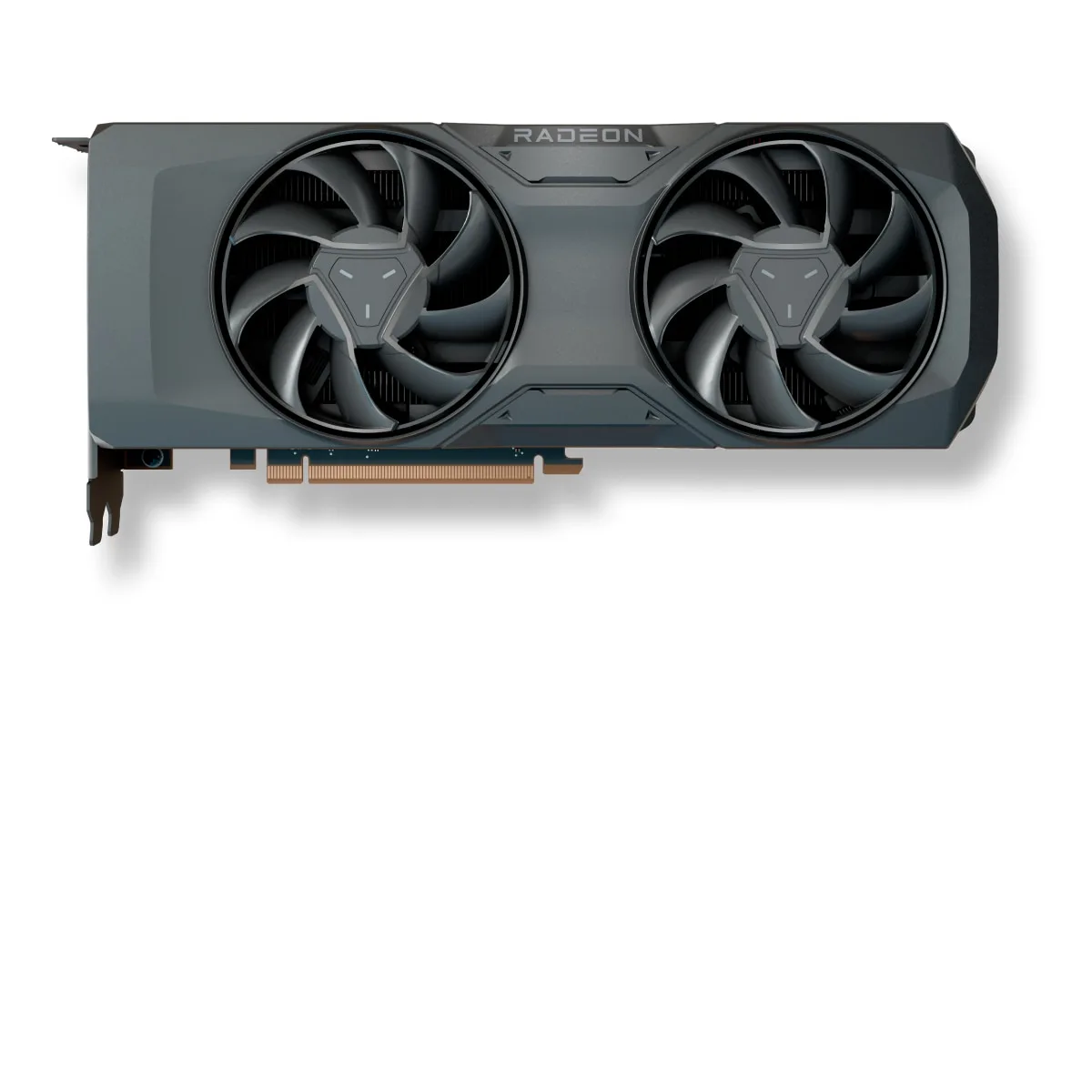
Image: · Advanced Micro Devices, Inc. (AMD) · Editorial/press (© AMD)
Reviews verdict
AMD's 16GB, $499 answer to the mid-range - a raster and value champion that stumbles the moment you switch on ray tracing.
AMD spent the RDNA 3 generation chasing Nvidia on price rather than the halo, and the Radeon RX 7800 XT is the sharpest expression of that strategy. At $499 with 16GB of memory, it targets the exact buyers Nvidia leaves exposed: people who want strong 1440p raster performance and generous VRAM without paying the green tax. It largely delivers - with a familiar Radeon asterisk.
The spec sheet
The 7800 XT is built on the Navi 32 chiplet die with 3,840 stream processors across 60 compute units, a 2,430 MHz boost clock, and - the headline - 16GB of GDDR6 on a 256-bit bus. Board power is 263W, fed by two 8-pin connectors. It launched September 6, 2023 at $499, undercutting Nvidia's nearest equivalents while handing you 4GB more memory and a wider bus.
How we tested
Same bench as always: Ryzen 7 7800X3D, 32GB DDR5-6000, Smart Access Memory enabled. We logged 1440p averages and 1% lows across our standard suite, using the reference-clocked card so board-partner factory overclocks don't flatter the numbers.
Performance: raster for the money
In pure rasterization the 7800 XT is excellent value and consistently edges ahead of the RTX 4070 (non-Super) while roughly matching or slightly trailing the 4070 Super depending on title. From our runs at 1440p:
- Cyberpunk 2077 (Ultra, no RT): ~92 fps average
- Call of Duty (High): ~140 fps
- Horizon Forbidden West (Very High): ~106 fps
- Starfield (High) - an AMD-favored title: comfortably ahead of the Nvidia competition
That 16GB buffer is the card's quiet superpower. Where 12GB cards start sweating with maxed textures and higher resolutions, the 7800 XT just keeps going, and it's the better bet for texture-heavy modern games and anyone dabbling at 4K. FSR has also matured into a usable upscaler, even if it still isn't as clean as DLSS in motion.
Power, thermals and the ray tracing problem
Efficiency is where AMD gives ground. At 263W the 7800 XT draws noticeably more than the ~220W 4070 Super for similar raster output, so it runs warmer and asks more of your PSU and case airflow. The reference cooler is competent rather than remarkable; most buyers will want a good board-partner triple-fan design.
Buy the 7800 XT for raster and VRAM, not for ray tracing. Switch on path tracing and the value proposition evaporates.
And that's the real reservation. Turn on demanding ray tracing and the 7800 XT falls well behind Nvidia - often by 30% or more in RT-heavy scenes, and it has no answer to DLSS Frame Generation's frame-rate multiplier or Nvidia's cleaner reconstruction. In Cyberpunk with RT Ultra it needs aggressive FSR just to stay comfortable, where the 4070 Super handles the same load with room to spare.
Verdict
The RX 7800 XT earns an 8.4. For raster-first 1440p gaming it's arguably the smartest money in the class: more VRAM, a wider bus, and a lower price than the Nvidia cards it lines up against. The score sits below the 4070 Super purely because ray tracing and upscaling - increasingly the reason people spend $500 on a GPU - are where AMD still trails, and because it burns more watts to get there.
Buy it if you play mostly rasterized games at 1440p, want 16GB of future-proofing, and don't care much about ray tracing. Skip it if path-traced eye candy, DLSS, or best-in-class efficiency top your list - that's Nvidia's turf, and the 7800 XT knows it.
- Pros: Excellent 1440p raster value, generous 16GB VRAM, 256-bit bus, aggressive $499 price
- Cons: Weak ray tracing, no Frame Gen equivalent at launch, higher 263W power draw, FSR still trails DLSS