 RigLoot
Samsung 990 Pro SSD Review
The fastest PCIe 4.0 SSD money can buy - a flagship that maxes out the standard just as PCIe 5.0 arrives to make you wonder why.
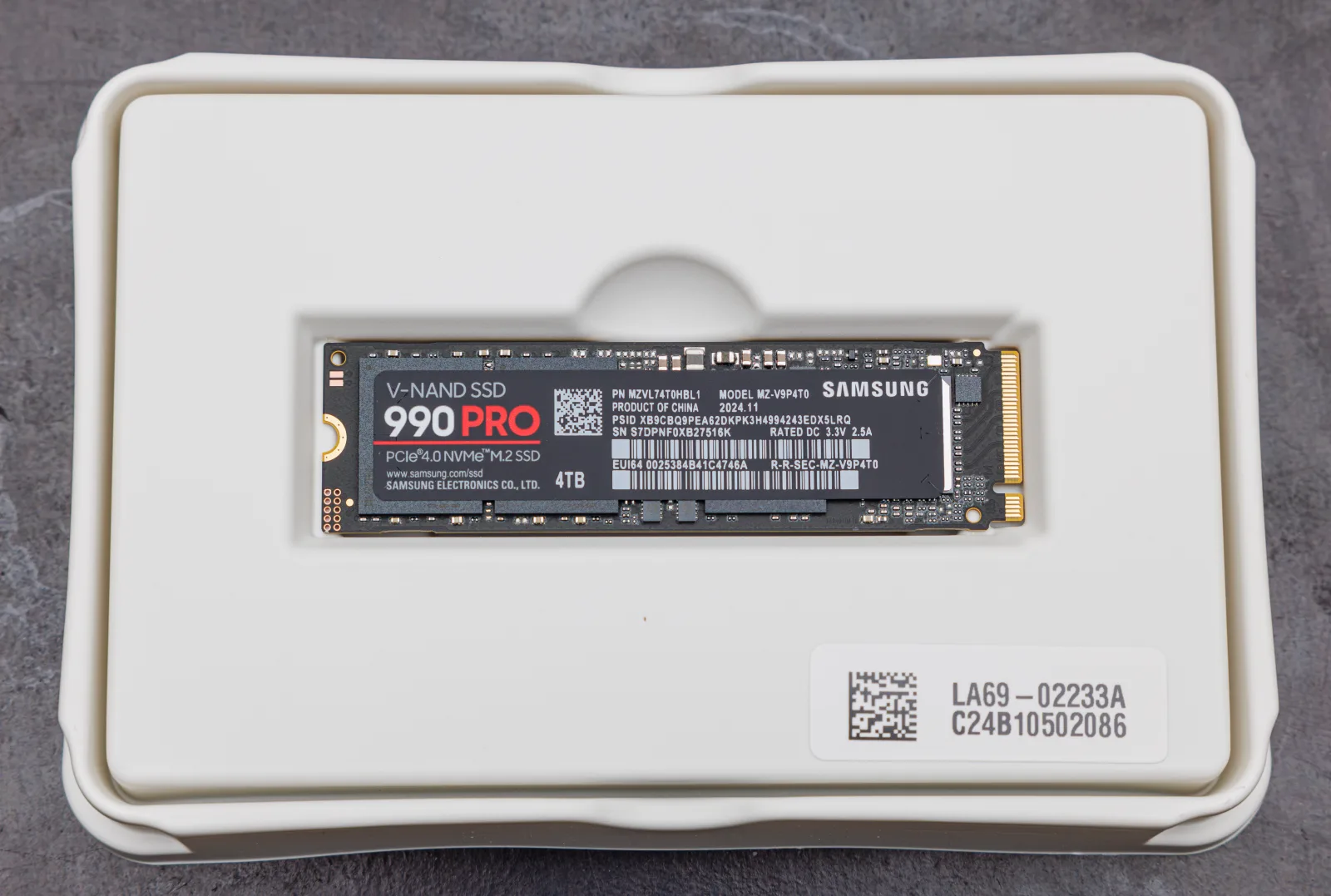
Image: · Dinkun Chen · CC BY-SA 4.0
Reviews verdict
The fastest PCIe 4.0 SSD money can buy - a flagship that maxes out the standard just as PCIe 5.0 arrives to make you wonder why.
Samsung took its time with the 990 Pro, and it shows. Where rivals chased PCIe 5.0 headlines, Samsung squeezed the PCIe 4.0 interface to its absolute limit and paired it with the efficiency and endurance that made the 980 Pro a default pick. The result is the best Gen 4 drive you can buy - which is either exactly what you want or slightly beside the point, depending on your motherboard.
The specs
The 990 Pro is a PCIe 4.0 x4, NVMe 2.0 drive in the standard M.2 2280 form factor, available with or without a low-profile heatsink. Samsung rates it at up to 7,450 MB/s sequential read and 6,900 MB/s sequential write, with random performance up to 1,400K/1,550K IOPS on the 2TB model. It pairs Samsung's in-house Pascal controller with V-NAND TLC. Capacities run 1TB, 2TB and 4TB, with endurance of 600 / 1,200 / 2,400 TBW respectively and a 5-year warranty. Launch pricing was around $169.99 for 1TB and $289.99 for 2TB.
How we tested
We ran the 2TB model as a boot and games drive in a PCIe 4.0 slot, mixing synthetic benchmarks (CrystalDiskMark, sustained-write torture tests) with the numbers that actually matter to gamers: real game load times and large-file transfer behavior once the SLC cache runs dry.
Performance: as fast as Gen 4 gets
In synthetics the 990 Pro hits its rated figures - our 2TB sample cleared 7,400 MB/s reads comfortably, and it sits at or near the top of every PCIe 4.0 chart. But the more interesting story is where it doesn't slow down:
- Random performance - the metric that governs OS snappiness and game loading - is genuinely class-leading
- Sustained writes hold up well past the SLC cache before tapering, better than most Gen 4 competitors
- Game load times are excellent - though, and this matters, near-indistinguishable from good mid-tier Gen 4 drives in practice
Samsung also fixed the 980 Pro's biggest black mark: power efficiency and thermals. The 990 Pro runs cooler and draws less power under load than its predecessor, so the bare (non-heatsink) version stays in check under a motherboard M.2 shield without throttling in normal use - a real improvement for laptops and small-form-factor builds.
The 990 Pro wins every PCIe 4.0 benchmark. Whether you'll feel that win outside a benchmark is the honest question.
The honest reservation
Two caveats. First, this is a Gen 4 flagship launched as PCIe 5.0 drives arrive - so if your platform supports Gen 5 and you want the absolute peak sequential numbers, this isn't that drive. Second, and more practically: for pure gaming, the real-world gap between the 990 Pro and a solid, cheaper Gen 4 drive is small. DirectStorage and typical game loads simply don't saturate this much bandwidth yet. You're paying a flagship premium for headroom, endurance and Samsung's proven reliability more than for load times you'll notice.
Verdict
The Samsung 990 Pro earns an 8.8. It is the best PCIe 4.0 SSD on the market - fastest in class, much improved on efficiency and thermals, backed by strong endurance and a 5-year warranty. It falls short of a perfect score only because it arrives as the standard it maxes out gives way to PCIe 5.0, and because the everyday gaming benefit over cheaper Gen 4 drives is thin.
Buy it if you want the definitive Gen 4 drive, value reliability and endurance, or run write-heavy creative workloads where the sustained performance pays off. Skip it if you're a pure gamer on a budget - a mid-tier Gen 4 drive gets you 90% of the experience for less - or if you have a Gen 5 platform and want the newest ceiling.
- Pros: Fastest PCIe 4.0 performance, class-leading random IOPS, improved efficiency and thermals, strong endurance, heatsink option, 5-year warranty
- Cons: Flagship price, limited real-world gaming gain over cheaper Gen 4 drives, launched just as PCIe 5.0 lands